High stakes poker

Does anyone not yet understand that the game advertised and sold to voters/investors was never the real one being played? Sure, Trump may favour a return to fiscally responsible governance, but his lack of action here, much to the consternation of some in the MAGA camp, is because he has much bigger fish to fry first. That is the restoration of what has been described as Hamilton's American system, while neutralising the challenge to US dollar reserve currency supremacy; not so much from the Chinese Renmimbi, but more importantly the Euro and the interested parties that lie behind this.
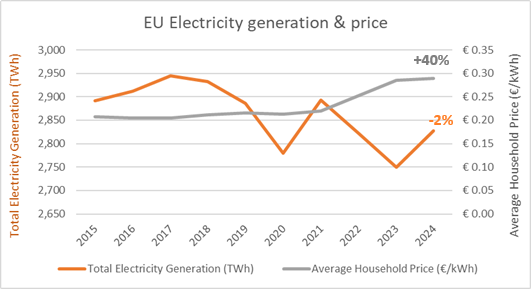
What we are currently witnessing is the re-assertion of realpolitik over Idealpolitik (with its tangled web of globalist 'rules based orders'), by the only nation with the economic and military muscle to do this, the US. Instead of Net-Zero, Trump is re-establishing not just US energy independence, but energy dominance. COmpare this with the EU, where even after pumping in an estimated cumulative public investment (specifically by EU governments) in renewable energy over the last decade (2015–2025) of approximately €1.1 trillion to €1.3 trillion, 69% of the EU's gross available energy was still derived from hydrocarbons, with 59% being from oil/gas. If falling unit energy costs and increased consumption are associated with economic and civilisational development, then presumably the reverse applies, particularly in a relative situation where one party is competitively disadvantaged. In that context, it may be relevant to note that this is exactly where the recent net zero agenda's have brought the EU to, with total electicity generation from 2014 to 2024 declining by -2%, while unit prices increased by +40%.
The US in the meantime, may account for up to 20% of global oil supply in 2026, with natural gas production share estimated at around 24-25.5% (2024). While production from the recently 'annexed' Venezuela has shrunk from a peak of ~7% share of global supply at its peak to only around 1%, it also sits on the World's largest (albeit heavy) oil reserves estimate at 17-18%, reserves that now seem under the control of the US, rather the venezuelan's previous associates, the CCP.
Denied guaranteed access to cheap Venezuelan oil, the Chinese are therefore increasingly reliant on Russian and ME oil, in particular from it's regional ally and bilateral trading pertner, Iran's IRGC. In 2025, China solidified its position as Iran's primary energy partner, purchasing an average of 1.38 million barrels per day (mbd) of Iranian crude. This accounted for approximately 80% to 90% of Iran's total seaborne oil exports and roughly 13% of China's total crude imports. The other side of this bilateral trade including the sales of military equipment, including CM-302 anti-ship missiles and no doubt plenty of other 'sensitive stuff', perhaps relating to both its ballistic missile and nuclear programmes.
Combine access to large numbers of balistic missles and drones with at least 440 kg of 60% enriched uranium (capable of being enriched to 90% to support 10 nuclear warheads *1) with a radcal islamic regime and clearly that is a recipe for disaster. Not just for Israel, where the IRGC has made no secret of wiping off the map, but also for all its gulf neighbours. For those wishing to present a narrative of Trump doing Israel's bidding on attacking Iran, the timing and real impetus seems more from Saudi Arabia and other gulf states who fear a strident and militarily dominant Iran doing to them what they've been doing to their own population for the last 47 years. That also suggests that there will be no easy settlement to leave a possible resurgent IRGC regime around to continue to plague its neighbours in revenge.
--------------------------
- *1 note: Enriching uranium from 50% to 90% is technically straightforward and requires significantly less effort than the initial stages of enrichment. While starting from natural uranium (0.7% U-235) is the most energy-intensive phase, once the material reaches 50%, the vast majority of the "separative work" has already been completed.
Key Requirements and Effort
Separative Work Units (SWU): The effort to move from 50% to 90% is a small fraction of the total work needed to reach weapons-grade from scratch. Experts note that aboutof the work is already done by the time uranium reaches enrichment. - Reduced Material Volume: At high enrichment levels, there is far less uranium-238 left to remove, meaning the total mass of material being processed is much smaller.
- Equipment: A standard gas centrifuge cascade can be rearranged to handle higher enrichments. Because there is less material, far fewer centrifuges are required for this final stage than for the initial low-enrichment stage.
- Timeframe: Going from highly enriched levels (like 60%) to 90% is often described as "trivial" by experts, potentially taking only a week or less in a functional facility.
----------------------
A conclusion from all of this is that once started, Trump's gulf allies will insist the US sees this through to the effective extinction of the IRGC regime as a military threat to the region. Whatever the claimed two week 'cease-fire', the current distributed authority to its > 30 regional commands suggests little chance of making anything stick here and that the next move will need to be from the Iranian army command which has so far remained on the sidelines, while avoiding being targetted by the US/IDF. With the Shah pretender calling on the army for support, perhaps the current two week ceasefire window is really intended to see which side the army takes and which may then determine whether they start to be included in the air strikes.
In the meantime, Trump's attack on Kharg island effectively neutralises the IRGC's attempts to continue to supply its Chinese ally, while also thwarts the attempt to split NATO by cutting separate supply deals, such as those with Macron's France.
With the military escalations, positions have now been polarised, and which will be very difficult to come down from. The gulf states are now openly in opposition to the IRGC and won't want to be left to face their wrath should the US now back out. On the other hand, many European Nato members have exposed themselves as being in active opposition to Trump and his gulf allies actions, to the point of denying overflight and in the case of France negotiating separate supply deals with the IRGC to navigate the straits of Hormuz. Its been no secret that the EU/UK establishment have activiely conspired against both Trump's elections (remember the MI5 and fake Steel document) as well as a resolution to the Russia/Ukraine conflict (since 2022 & Boris Johnson's intervention). Perhaps they now see an opportunity to discredit Trump ahead of the US mid-terms in November to make him the proverbial 'lame duck' and thereby outlast him to keep to their 2030 agenda. Any supposedly supportive visits to the Gulf by European politicians will therefore be no more to effect a real resolution to the IRGC problem, than their similar attempts with Ukraine. No doubt Trump is now more than aware of their motives as they will be of the consequences should the Iranian army intervene to restore a Shah and replace the IRGC.
Having secured control of Gulf oil flows on top of US and Venezuela, Trump will force a Ukraine Russia settlement and which in turn will strengthen his hand with negotiations with China, who will be offered one of his deals, otherwise no oil. As for Europe, more pain as the existing regime clings on despite collapsing economic growth and growing political and societal dissent. If the Gulf states fear reprisals from the IRGC, should the latter remain in power, the EU ought to be no less worried at a similar fate to befall them for betraying Trump in relation to the IRGC. A new power order is being constructed, with the US (including the Gulf states), Russia and China reaching a mutually beneficial economic accomodation, while Europe is reduced to a side-show while it remains captured.
In the meantime, those hoping for some early action by a Republican controlled Congress and Presidency would restore some financial probity to the US goverment may be forgiven for being disappointed. Yes, GDP growth, while lumpy, has remained faired robust, but then so it ought have done while government spending remains unchecked and the other side of this growth is the rising Federal debt being used to fund much of this.
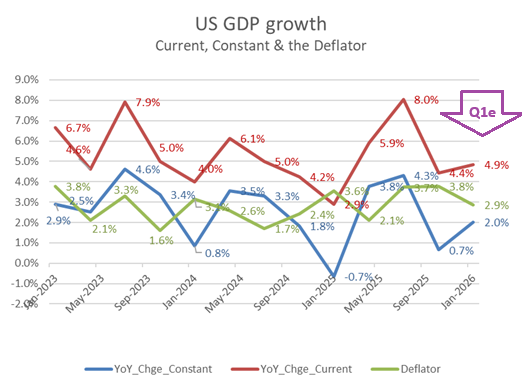
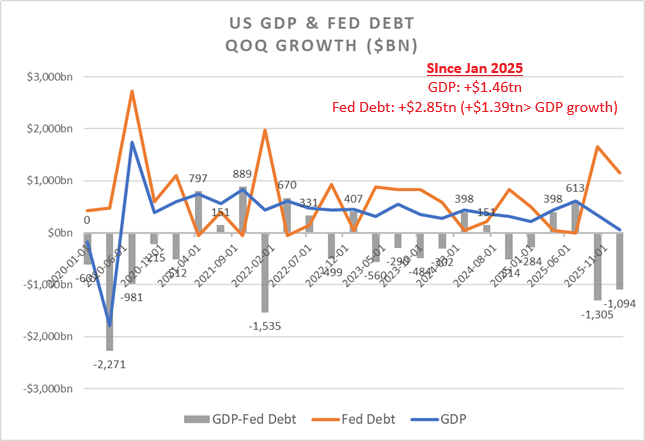
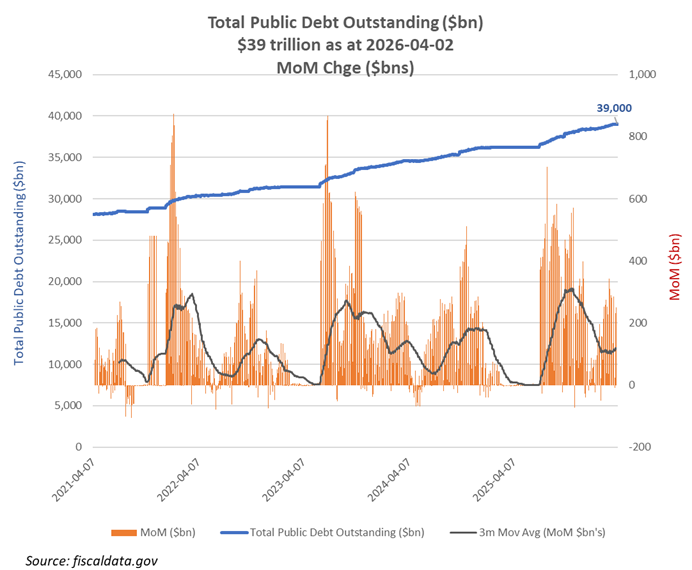
If anyone was hoping that Republican control of both houses of Congress and the Presidency would herald a return to sound financing, Trump's 'Big Beautiful Bill' seems to disabuse markets of thius notion; good for assets, but less so for the US dollar, while also keeping bond yields elevated. To put some numbers on to that, Federal debt has burgeoned by a further $2.85tn under Trump's first 14 months and while the above GDP numbers may have been better than feared, the cumulative increase over the same period has amounted to only US$1.46tn, which is not much more than half of the increase in Federal debt. Fool's gold!
Take away the date on the below chart of US public debt outstanding and one might be hard pressed to tell the difference between Biden's Democrat administration and Trump's Republican one.
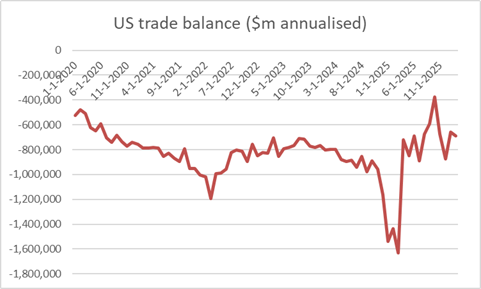
But what about that other deficit, weighing on the US dollar, that being the trade deficit. Here the cenral plank of Trumps agenda is the return of domestic manufacturing from a revival of Hamilton's American System and in particular with the application of protective tariffs. While the last point on this chart shows an improving trajectory, with the annualised deficit dropping below $700bn, the significant volatility obscures the trend and how this will develop, Stretch the perspective out for the first 14 months of his administration and the cumulative trade deficit has topped $1bn, as compared to under $800bn for the first 14 months of Biden's presidency. Ouch!
In light of the continued reflationary fiscal spending and with domestic manufacturing supported by tariffs, the US jobs data has remained broadly positive, albeit lumpy, a feature supported by both the BIS non-farm payroll surveys as well as the statistically more robust insured unemployment claims data.
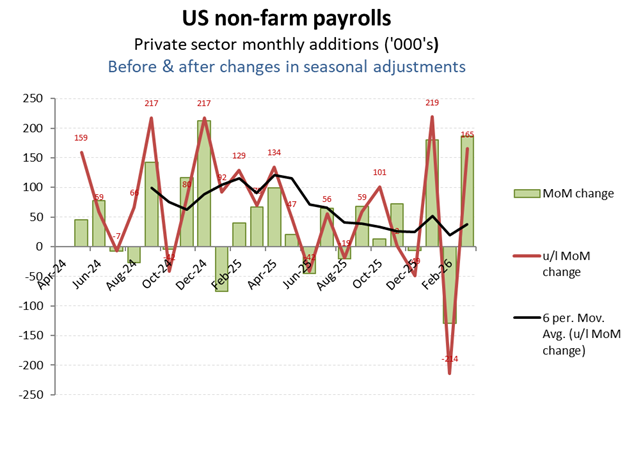
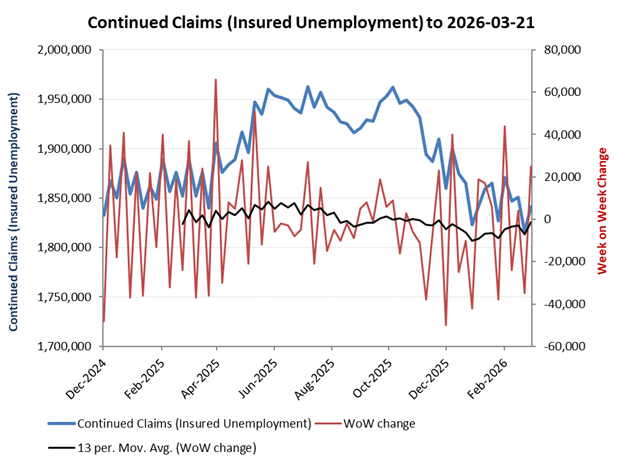
Drill down into the recent jobs data and the broad trends ought not come as too much of a surprise. Manufacturing, mining and construction industries have remained fairly buoyant, partially offset by sharp contractions in IT and Financial Services, as heavy AI investments are rolled out.
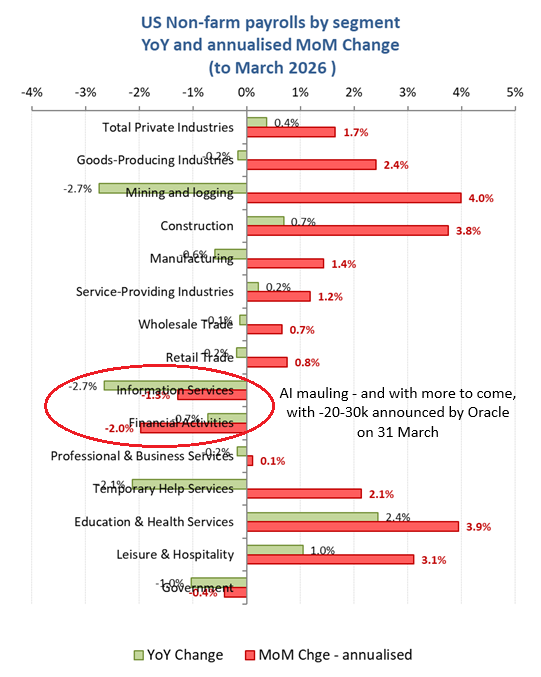
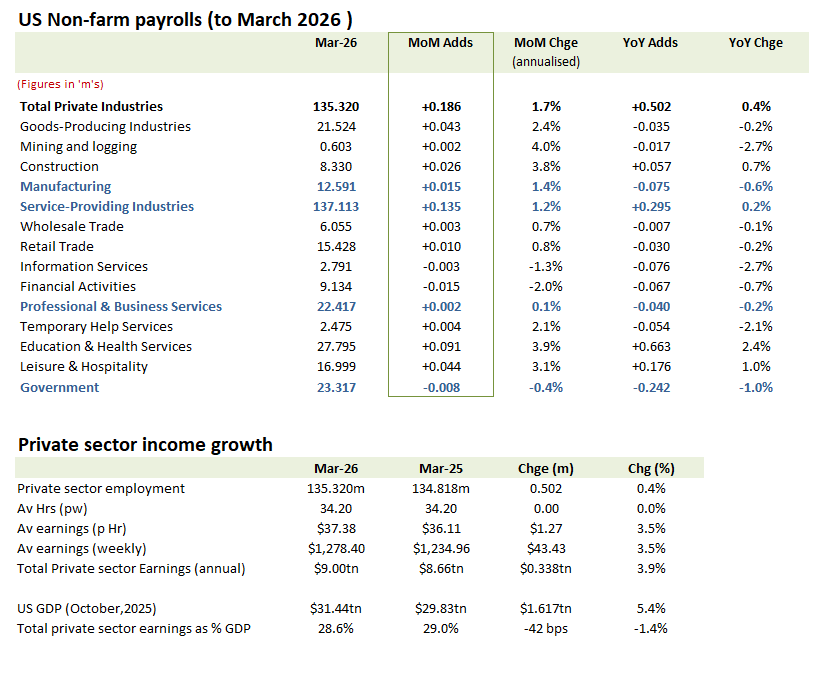
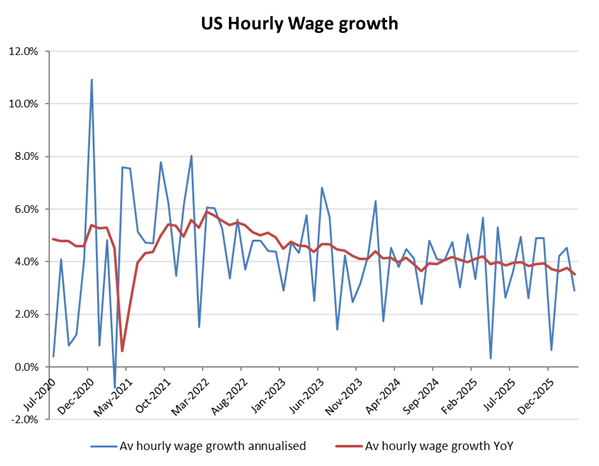
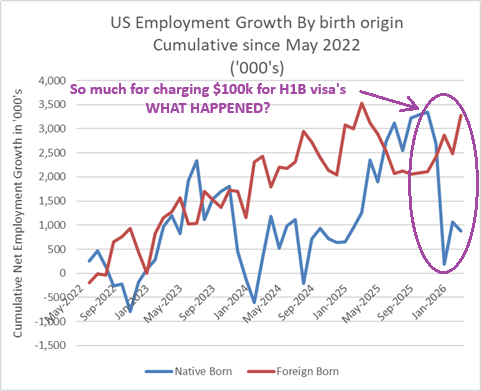
An interesting feature of the recent US jobs data however, is that when you drill down into the weeds, some of the results are counter-intuitive to what one might have expected given the administrations recent policy decisions. An example of this can be seen when looking at job growth by birth origin. Supposedly, Trump's well publicised policy changes to H1B employment visa's, raising the charge to a hefty $100k, was intended to enhance employment and skill formation/retention of domestic employees and particular in the high remuneration segments of IT. At first, this seems to have been working, with native born recruitment rebounding after the Biden years dearth. However, from Q4, there has been a sharp reversal of this with a collapse in native born employment, while these get replaced by foreign born placements. That this has coincided with some major layoff programmes by IT groups such as Microsoft (-15k in 2025), Intel (-21-27k in 2025), Amazon (-25-30k for 2025 and 2026) and more recently Oracle (-30k notoriously announced with a 6am email to thioe fired).
While some of those domestic job losses will undoubtedly be replaced by off-shoring, the below data on increased jobs going to foreign born seem to confirm some of the indusrty speculation that enough loopholes and legal exemptions still exist for these groups to circumvent some of the visa restriction. Perhaps these are unforseen gaps in the new visa regulations, albeit given the lack of progress on tightening up on broader government finances, one might also be forgiven to see this as part of broader pattern of political dissembling to keep markets and the economy warm while trying to impose a new global order on energy.